
The Chinese government has blocked a US federal employee from leaving China, the US state department has confirmed.
The federal employee works for the US Patent and Trademark Office, and was visiting China in a personal capacity, according to the state department. “We are tracking this case very closely and are engaged with Chinese officials to resolve the situation as quickly as possible,” a spokesperson said.
Chinese authorities confirmed that another American, Wells Fargo banker, Chenyue Mao, had also been blocked from leaving. Both individuals have been subjected to an “exit ban”.
Exit bans are a controversial mechanism used by the Chinese government to bar both Chinese citizens and foreigners from leaving, for reasons ranging from criminal investigations to unsettled civil disputes, but is also used as a leverage tool in diplomatic disputes.
The exact reasons for the federal employee’s exit ban are unclear, but the Washington Post had previously reported that the worker, whose identity has not been released, was stopped from leaving the country after he failed to disclose his government employment on the visa application. He reportedly had also served in the US Army.
It has been reported as the first time a US government employee has been affected.
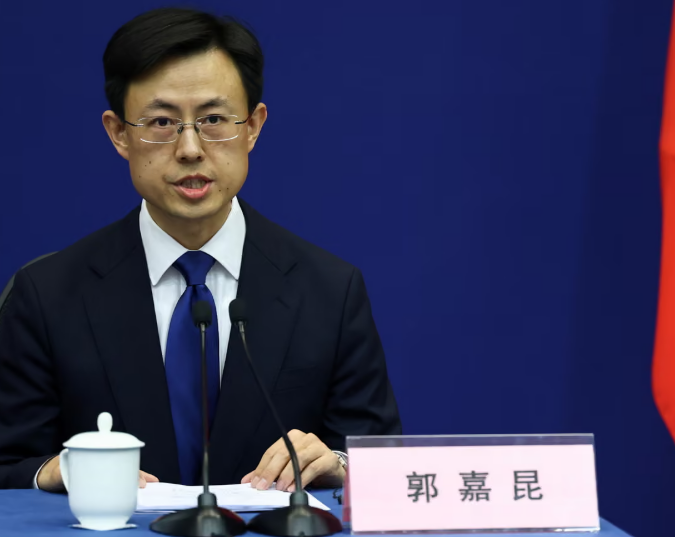
Chinese foreign ministry spokesman, Guo Jiakun, said he had “no details to share” about the case when asked at a regular press briefing on Monday. However, Guo did confirm the exit ban on Mao, saying she was involved in a criminal case and obliged to cooperate with an investigation.
“Chenyue Mao is involved in a criminal case currently being handled by Chinese law-enforcement authorities and is subject to exit restrictions in accordance with the law,” Guo said.
Wells Fargo has since banned all employees from travelling to China since Mao – a naturalised US citizen of Chinese descent – was stopped from leaving.
A 2023 report by Safeguard Defenders said that since Xi Jinping came to power in 2012, “China has expanded the legal landscape for exit bans and increasingly used them, sometimes outside legal justification”.
Exit bans have been used against activists and journalists – including foreign correspondents – and family members of the people actually of interest to the Chinese government. In 2019 two American siblings were allowed to return home after three years trapped in China. Cynthia and Victor Liu were subject to an exit ban, despite not facing any criminal allegations. Their father, a former bank official and fugitive Liu Changming, was wanted in China to face fraud charges.
At this dangerous moment for dissent
I hope you appreciated this article. Before you close this tab, I wanted to ask if you could support the Guardian at this crucial time for journalism.
When the military is deployed to quell overwhelmingly peaceful protest, when elected officials of the opposing party are arrested or handcuffed, when student activists are jailed and deported, and when a wide range of civic institutions – non-profits, law firms, universities, news outlets, the arts, the civil service, scientists – are targeted and penalised by the United States federal government, it’s hard to avoid the conclusion that our core freedoms are disappearing before our eyes – and democracy itself is slipping away.
In any country on the cusp of authoritarianism, the role of the press as an engine of scrutiny, truth and accountability becomes increasingly critical. At the Guardian, we see it as our job not only to report on the suppression of dissenting voices, but to make sure those voices are heard.
Not every news organisation sees its mission this way – indeed, some in the US have been pressured by their corporate and billionaire owners to avoid antagonising the government. I am thankful the Guardian is different.
Our only financial obligation is to fund independent journalism in perpetuity: we have no ultrarich owner, no shareholders, no corporate bosses with the power to overrule or influence our editorial decisions. Reader support is what guarantees our survival and safeguards our independence – and every penny we receive is reinvested in our work.
The Guardian’s global perspective helps contextualise and illuminate what we are experiencing in this country. That doesn’t mean we have a single viewpoint, but we do have a shared set of values. Humanity, curiosity and honesty guide us, and our work is rooted in solidarity with ordinary people and hope for our shared future.
It has never been more urgent, or more perilous, to pursue reporting that holds power to account and counters the spread of misinformation – and at the Guardian we make our journalism free and accessible to all. Can you spare just 37 seconds now to support our work and protect the free press?
We value whatever you can spare, but a recurring contribution makes the most impact, enabling greater investment in our most crucial, fearless journalism. As our thanks to you, we can offer you some great benefits – including seeing far fewer fundraising messages like th
The Gordian