
 By: Shatha Kalel
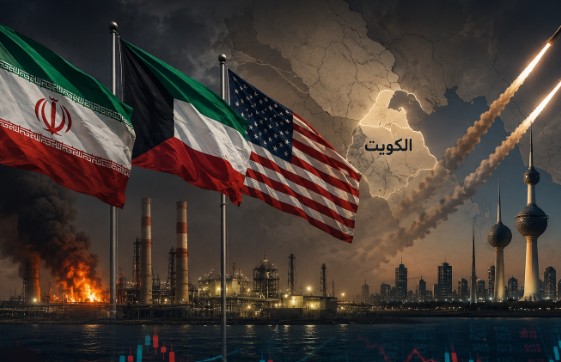
The targeting of Kuwait’s electricity generation and water desalination facilities was not merely another military escalation in the growing confrontation between Iran and the United States. Rather, it represents a strategic shift that could redefine the nature of conflict across the Middle East. The attack sends a message that extends far beyond Kuwait’s borders: regional competition is no longer confined to military bases and conventional deterrence but has expanded to include the economic infrastructure that underpins national stability and daily life.
This development signals the emergence of what can be described as “economic and infrastructure warfare,” where power plants, desalination facilities, ports, and telecommunications networks become strategic targets as significant as military airports and air bases. In a region that relies heavily on electricity and desalinated water, disrupting these critical services affects far more than daily life. It interrupts industrial production, increases transportation and insurance costs, weakens investor confidence, and places additional pressure on public finances.
The attack on Kuwait cannot be understood in isolation from broader global developments. Since the COVID-19 pandemic, followed by the Russia-Ukraine war, the Red Sea crisis, and recurring tensions surrounding the Strait of Hormuz, geopolitics has become a defining force shaping the global economy. Nations are no longer competing solely for military influence but also for control over trade corridors, energy security, supply chains, and critical infrastructure.
Within this context, Kuwait represents far more than a Gulf state under attack. It is an integral part of the global energy system, a major U.S. security partner, and a critical logistical hub supporting American military operations in the Gulf. Consequently, any attack on its strategic infrastructure carries implications that extend well beyond immediate military calculations. It sends a broader message to Washington and its allies that the costs of continued escalation will no longer be confined to the battlefield but will increasingly affect regional economies and global markets.
From an economic perspective, the escalation raises questions that go far beyond the immediate physical damage. Is the Middle East entering an era in which civilian infrastructure becomes a primary instrument of strategic deterrence? Are we witnessing the transition from a conflict over territory to a conflict over economic resilience? And if this pattern continues, what will be the long-term consequences for oil markets, foreign investment, maritime insurance, and the Gulf states’ ambitious economic diversification strategies?
The answers to these questions concern not only Kuwait or Iran but the future of the entire Middle East. As the relationship between national security and economic security grows increasingly intertwined, protecting critical infrastructure is becoming essential to maintaining market stability and sustainable growth. Understanding this attack therefore requires viewing it not as an isolated military incident, but as part of a broader transformation in the regional balance of power—one in which economic resilience may prove just as decisive as military capability.
Economic Studies Unit – North America Office
Center for Linkage Studies and Strategic Research