
BY: Shatha Kalel
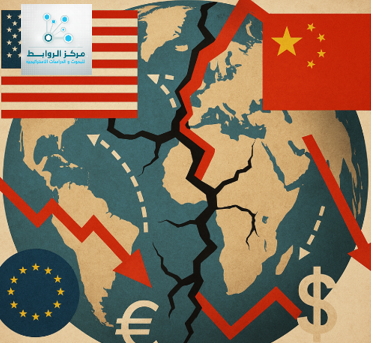
The year 2025 marked one of the most significant turning points in modern political and economic history. It represented the beginning of the breakdown of the liberal world order that had been established after the Second World War. During this period, President Donald Trump introduced a series of bold political and economic decisions that reshaped the structure of global trade, the role of international institutions, security alliances, and the overall leadership position of the United States. These actions created widespread uncertainty and instability, not only within the United States but throughout the global economy. As a result, 2025 became a defining moment in the evolution of international relations and global power dynamics.
Trump’s economic protectionism, particularly his imposition of tariffs, had a profound effect on global trade. Confidence in the World Trade Organization declined, supply chains began to fragment, and production costs rose sharply, contributing to global inflation. These policies also pushed multinational companies to reconsider the locations of their factories, relocating parts of their production to countries such as India and Vietnam to reduce reliance on China and the United States. Meanwhile, the European Union and China sought to strengthen their economic independence by increasing domestic production, boosting defense spending, and preparing for a less cooperative and more unpredictable world.
The effects of these shifts were not limited to trade. Financial markets experienced waves of volatility due to rising interest rates, declining stock markets, and a growing flight of investors toward safe assets such as gold and government bonds. These developments placed additional pressure on developing economies, which depend heavily on loans and international aid. At the same time, the transformation of long-standing security alliances into payment-based relationships increased global tensions, triggered a new arms race, and allowed powers such as China and Russia to expand their influence in regions traditionally aligned with the United States.
On the scientific and technological front, these changes weakened the United States’ position as a global leader in research and innovation. Universities faced political and financial pressure, research funding declined, and academic migration slowed, pushing many researchers and scholars toward more stable countries such as Canada and those in the European Union. This shift reduced America’s ability to maintain its leadership in technological innovation, opening the door for other powers to fill the gap.
Given these developments, the global economy after 2025 became more fragmented and complex. International institutions lost influence, trade wars increased, and geopolitical risks rose, all contributing to a noticeable slowdown in global growth. The world has now entered a new phase of multipolarity, where the United States is no longer the sole dominant force guiding the direction of the global economy. Instead, it is now part of a more competitive and contentious global landscape.
Conclusion
The transformations of 2025 show that the world stands at a crossroads. Nations must choose between adapting to a new global system based on economic competition and multipolar power or confronting a deeper period of instability and prolonged conflict. This new era challenges countries and international institutions to redefine the rules of economic cooperation and restore stability in a system that is being reshaped from the ground up.
Economic Studies Unit / North America Office
Al-Rabetat Center for Research and Strategic Studies