
BY: Shatha Kalel
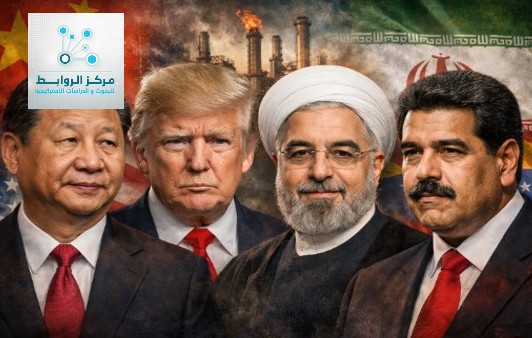
China’s stance toward international crises is often misinterpreted as being driven by “ideological alliances,” whereas the reality is far more pragmatic. In other words, political or ideological language may appear in official discourse, but actual behavior is shaped by interests, practical calculations, and cost–benefit assessments. The difference in Beijing’s approach to Iran and Venezuela reflects not political preference, but considerations related to energy security, geography, sanctions risks, and the balance of power with the United States.
First: Geopolitical Location and Strategic Importance
Iran occupies a highly strategic geographic position at the heart of the Middle East, near critical global energy corridors, most notably the Strait of Hormuz. For China, the Middle East is a cornerstone of long-term energy security and diplomatic expansion. Sino–Iranian relations have also been strengthened through long-term cooperation frameworks, giving the relationship a strategic dimension that goes beyond short-term interests.
By contrast, Venezuela is located in the Western Hemisphere, within a zone of direct and historical U.S. influence. This makes broad Chinese support for Venezuela far more costly politically and economically, and exposes Beijing to direct confrontation with Washington in a region where U.S. leverage is stronger.
Second: Economic Differences and the Oil Sector
Iran represents a larger and relatively more diversified economy than Venezuela, despite sanctions. Iranian oil exports provide China with a significant economic opportunity, allowing Beijing to secure discounted crude that Tehran struggles to sell on global markets. This creates a mutually beneficial relationship, even under international constraints.
Venezuela, despite holding the world’s largest proven oil reserves, suffers from severe structural deterioration in its oil sector due to weak investment, declining infrastructure, and technological shortages. China’s earlier experience with oil-backed loans in Venezuela has also made it more cautious, as the relationship shifted from strategic partnership to risk management and debt recovery.
Third: Sanctions and Risk Calculations
In Iran’s case, China follows a policy of “calculated support.” While it opposes unilateral sanctions in principle, it limits cooperation to practical areas and avoids commitments that could expose major Chinese firms to direct penalties.
In Venezuela, the sanctions environment is more volatile. The U.S. relies on a shifting licensing system that intermittently allows exports and then reimposes restrictions depending on political conditions. This uncertainty makes long-term Chinese investments riskier and less attractive.
Fourth: Diverging U.S. and Chinese Interests
The United States toward Iran focuses on preventing nuclear escalation and curbing Tehran’s regional influence, using sanctions to restrict financial resources.
Toward Venezuela, U.S. policy aims to manage regional stability and migration, while employing sanctions as political leverage, with attention to oil market implications.
In contrast, China views Iran as a key partner for energy security and as evidence that U.S. influence in the Middle East is not absolute. Toward Venezuela, China prefers to maintain minimal engagement, protect existing interests, and avoid direct confrontation with Washington in a sensitive region.
Conclusion
China’s stronger support for Iran compared to Venezuela is not ideological but the result of precise strategic and economic calculations. Iran offers higher value in terms of energy and geopolitics with risks that can be contained, while Venezuela represents a high-risk case with lower returns in an environment dominated by U.S. power. Accordingly, China acts pragmatically: providing measured support where benefits outweigh costs, and exercising extreme caution where U.S. pressure tools are more decisive.
Economic Studies Unit – North America Office
Center for Linkage Studies and Strategic Research