
By:Shatha kalel
The Economic and Political Logic Behind the World’s Most Dangerous Relationship
Despite trade wars, technological rivalry, and competition for global influence, the relationship between the United States and China remains one of the most complex relationships in modern history. The world often sees aggressive rhetoric between the two powers, tariffs, disputes over technology and Taiwan, yet it also sees repeated summits, negotiations, and attempts to contain tensions. The reason is simple: the world’s two largest economies cannot fully separate from one another because a major economic confrontation between them could shake the entire global economy.
Donald Trump built a large part of his political identity around being “tough on China.” Since his first presidential campaign, he argued that Beijing had benefited for decades from trade with the United States at the expense of American industry and jobs. That is why he imposed massive tariffs on Chinese goods and attempted to reduce American dependence on China in supply chains and technology.
Yet despite this escalation, Trump understands that the American economy itself cannot rapidly disconnect from China. China is not only a political rival, but also a massive trading partner and a huge market for American companies. This is why Trump constantly tries to balance pressure on Beijing while avoiding a full economic confrontation that could damage the U.S. economy and financial markets during politically sensitive periods.
Economically, the United States still needs China for several reasons. American companies have relied on Chinese manufacturing for years because of lower production costs, rapid industrial capacity, and China’s enormous manufacturing infrastructure. At the same time, the Chinese market represents a huge opportunity for American companies in technology, aviation, agriculture, and energy.
This explains why Trump repeatedly focuses on deals involving:
Chinese purchases of American agricultural products
Chinese imports of U.S. oil
Boeing aircraft agreements
Maintaining trade stability and temporary truces
These issues are directly connected to American jobs, markets, and economic growth.
China, meanwhile, also needs stable relations with the United States despite the political rivalry. The Chinese economy depends heavily on exports and industrial growth, and the American market remains one of the most important destinations for Chinese goods. Beijing understands that a full-scale economic confrontation with Washington could trigger:
capital flight
market instability
slower economic growth
pressure on the Chinese currency
rising unemployment
For this reason, China tries to present itself as a stable and rational global power in contrast to what it sometimes describes as “American unpredictability.” Beijing also seeks to use global tensions to position itself as a more reliable economic and trade partner for other nations.
However, the real conflict between the two sides is no longer just about trade. It has evolved into a race for global leadership in:
artificial intelligence
semiconductors
advanced technology
military influence
economic dominance
The United States fears that China could become the world’s leading technological superpower, which is why Washington continues restricting exports of advanced chips and sensitive technology to Beijing. China, on the other hand, views these restrictions as an attempt to prevent it from catching up with Western dominance in technology and economics.
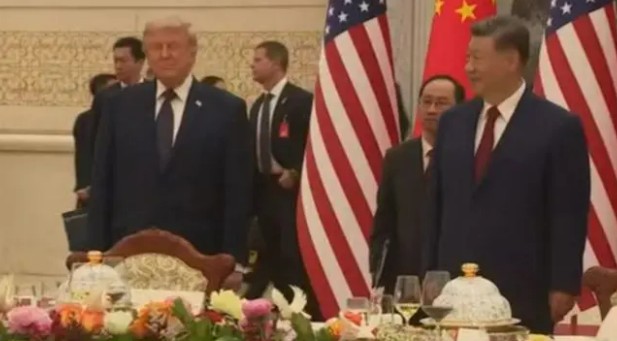
Politically, the relationship is even more complicated. Trump wants to appear as a strong leader who does not allow China to “take advantage” of America, while at the same time keeping communication channels open to avoid a global economic shock. Chinese President Xi Jinping, meanwhile, tries to present himself as a calm and strategic leader capable of managing relations with Washington without weakening China’s international standing.
This is why meetings between Trump and Xi are not only about trade. They also involve highly sensitive issues such as:
Iran
oil markets
the Strait of Hormuz
Taiwan
artificial intelligence
global security
Any tension between the world’s two largest economies immediately affects:
oil prices
financial markets
global trade
inflation
investment flows
international supply chains
This explains why both sides continue trying to avoid a complete rupture despite deep disagreements. The conflict between Washington and Beijing is not a normal geopolitical dispute. It is a struggle over the future shape of the global order. The United States wants to preserve its technological and economic dominance, while China believes the time has come to expand its influence and emerge as the world’s leading power.
Yet the deeper reality is that the modern world has become so economically interconnected that even rivals still need one another. That is why competition and political tensions may continue, but a complete economic separation between the United States and China remains highly unlikely in the near future.
Economic Studies Unit – North America Office
Center for Linkage Studies and Strategic Research