
BY: Shatha kalel
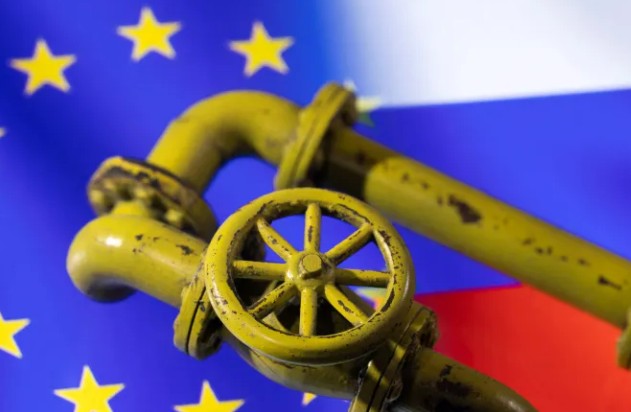
45%, 152 billion cubic metres, then just 12%. These figures capture one of the most significant transformations in Europe’s energy landscape in decades. In 2021, Russia supplied around 45% of the European Union’s gas imports, amounting to nearly 152 billion cubic metres. By 2025, Russian gas imports had fallen to approximately 36 billion cubic metres, reducing Russia’s share to around 12%.
Yet behind this dramatic decline lies a battle far more complex than simply replacing one gas supplier with another. Europe wants to end decades of dependence on Russian energy, while Moscow is trying to preserve its markets and redirect a growing share of its exports eastward.
This raises the real question: Has Europe truly succeeded in freeing itself from Russian gas, or has it simply redistributed its dependence among other suppliers and markets?
From 45% to 12%: A Revolution in Europe’s Energy Map
For decades, the relationship between Russia and Europe was built on a clear economic equation: Russia had the gas and pipeline networks, while Europe had the market, industrial capacity, and enormous demand.
The Russia-Ukraine war fundamentally changed that equation.
The European Union began diversifying its energy sources, increasing imports of liquefied natural gas (LNG), accelerating investment in renewable energy, and reducing its dependence on Moscow.
But Russian gas did not disappear overnight.
In 2024, Russia’s share of total EU gas imports rose again to around 18.8%, while Russian LNG accounted for approximately 17.5% of the EU’s LNG imports.
This created a striking paradox: European policy was moving toward separation, while the European market continued buying Russian gas.
2027: Russian Gas Approaches Zero
In January 2026, the European Union moved from reducing its dependence on Russia to a much more decisive step, adopting legislation to phase out Russian gas imports.
Under the plan, imports of Russian LNG will be eliminated first, followed by Russian pipeline gas during 2027.
This represents a strategic shift aimed at ending an energy relationship built over decades.
But closing the door on Russian gas raises an even bigger question: Who will fill the gap?
45% LNG: A New Dependency?
Europe’s map of gas suppliers is changing rapidly.
In 2025, around 31% of EU gas imports came from Norway and approximately 26% from the United States, alongside supplies from North Africa, Azerbaijan, and Qatar.
The biggest transformation, however, has been the rise of LNG.
Its share of total European gas imports increased from approximately 20% in 2021 to around 45% in 2025.
This gives Europe greater flexibility. LNG tankers can arrive from several countries, unlike pipelines that physically connect consumers to specific suppliers.
But this flexibility comes at a cost.
LNG is exposed to global market prices, transportation costs, and competition with Asian buyers. Europe may therefore have reduced its dependence on Russia while becoming more exposed to a volatile global gas market.
Europe Is Not a United Front
The cost of breaking away from Russian energy is not distributed equally across Europe.
Countries with ports and LNG terminals can diversify their supplies more easily. Landlocked countries that have historically depended on Russian pipelines face more difficult choices.
This helps explain opposition from Hungary and Slovakia to the complete phase-out of Russian energy, amid concerns that more expensive alternatives could harm their industries and economies.
The gas battle has therefore become a test of European unity itself, not merely a test of Europe’s relationship with Moscow.
Russia Looks East
Meanwhile, the loss of a substantial part of the European market is forcing Russia to search for alternatives, particularly in China and across Asia.
But redirecting gas is not easy.
Oil can be transported by sea and redirected relatively flexibly. Large volumes of natural gas, however, depend on pipelines and infrastructure designed for particular markets.
Moscow therefore needs major investment, new pipelines, and long-term contracts if it hopes to compensate for the loss of the European market.
This creates another paradox: The more Russia needs China, the stronger Beijing’s bargaining position becomes.
Moscow may succeed in redirecting more of its exports eastward, but in doing so, it risks replacing a heavy dependence on Europe with increasing dependence on a major Asian buyer.
Who Holds the Power: The Gas or the Market?
This is the real battle behind the numbers.
Russia possesses some of the world’s largest natural gas reserves. But owning gas is not enough if the number of buyers declines or the routes needed to reach them become more expensive.
Europe, meanwhile, possesses an enormous market, but its ability to reject Russian gas depends on having reliable alternatives at prices that do not undermine its industries.
Energy does not create influence simply because it exists underground. Real power comes from the ability to produce it, transport it, sell it, and deliver it to the market at the right time and at a competitive price.
The Real Test
By the end of 2027, Europe may have closed one of the most important chapters in its economic relationship with Russia.
But success will not be measured simply by reducing Russian gas imports to zero.
It will be measured by Europe’s ability to secure energy at prices that preserve the competitiveness of its industries, and by Russia’s ability to find alternative markets without making substantial concessions on prices and contract terms.
In conclusion, the shift from 45% to 12%, and eventually toward the targeted zero by 2027, may appear to tell the story of Russian gas losing its position in Europe. In reality, however, it tells a much larger story about the restructuring of the global energy map.
Europe is attempting to transform energy security into strategic independence. Russia is trying to redirect its gas exports from West to East, while the United States, Norway, and other suppliers move to fill the gap.
Ultimately, the gas battle will not be won by the country with the largest reserves, but by the player that can reach the greatest number of markets at the lowest cost while maintaining the highest degree of independence.
Economic Unit – North America Office
Al-Rawabit Center for Research and Strategic Studies