
Yemen’s internationally recognised government has announced a major military campaign to retake all territory controlled by the Houthis, marking a new escalation in a civil war that had largely been frozen for several years before battles intensified in recent weeks.
The announcement by Rashad al-Alimi, chairman of the Presidential Leadership Council (PLC), the executive body of the Yemeni government, comes after weeks of heavy fighting and major Houthi advances along Yemen’s Red Sea coast and around the strategically important city of Taiz.
On Monday, Yemeni government forces said they were launching a “strategic” offensive on the country’s capital, Sanaa, which the Houthis have held since 2014.
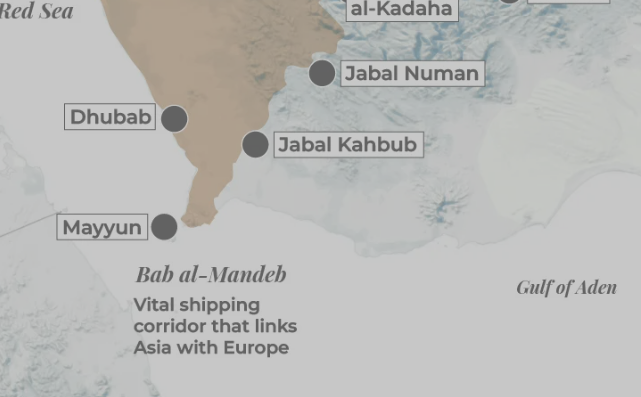
Earlier in the day, the Yemeni forces — who are backed by Saudi Arabia — said they had regained control of the Dhubab district on the country’s west coast near the Bab al-Mandeb strait, though the Houthis denied the announcement.
The fighting between the Iran-aligned Houthis – an armed group also known as Ansar Allah, meaning Supporters of God in Arabic – and Yemeni government forces has expanded since a fragile 2022 truce collapsed in July, displacing more than 100,000 people since then.
Last month, the Houthis launched a rapid offensive that captured about 150km (93 miles) of Red Sea coastline and areas around Bab al-Mandeb, the narrow waterway connecting the Red Sea to the Gulf of Aden, which is a critical route for international shipping.
On Monday, the foreign minister of Yemen’s internationally recognised government requested more support from the international community to defeat the Houthis, saying it is “in the world’s interest” for the country to be stable.
“We call upon our brothers, friends and the international community to support the Yemeni people, their state, and their national institutions in confronting the terrorist Houthi militia, which seizes their will by force of arms and lays waste to the lives of their sons – after exhausting all opportunities for de-escalation and peace,” Afrah al-Zouba said in a post on X.
So what is the latest on the fighting, and what does Yemen’s government hope to achieve?
What is the latest on the fighting?
The Yemeni government army said on Monday 1,747 Houthi fighters had been “neutralised” in 1,122 military operations in the Saada, al-Jawf and Taiz governorates and along Yemen’s western coast.
Al-Nuzaili said warplanes, drones, artillery, missiles and snipers were involved and 364 military and logistical vehicles had been destroyed or disabled. The casualty and equipment figures could not be independently verified.
Yemen’s internationally recognised government also announced that its forces had taken control of Dhubab on the Red Sea coast and were launching a major offensive on Sanaa.
Gaza orphan finds a family again after Israeli attack kills his own
Elsewhere, the front line in Marib governorate in northeastern Yemen witnessed an escalation in fighting on Monday.
A military source told Al Jazeera that government forces launched an attack on Houthi positions on the Raghwan front in the north of the governorate, coinciding with air raids on Houthi positions and reinforcements.
The source said the raids targeted Houthi positions near Mount Helan as well as an arms depot and military reinforcements northwest of Marib.
On Sunday, a Saudi-led coalition said its forces carried out 97 attacks against Houthi reinforcements around Taiz and the Tor al-Baha front using warplanes, drones, artillery, missiles and snipers.
On the developments in Taiz, Al Jazeera’s Yemen bureau chief, Saeed Thabet, said Houthi operations in the rural areas around the strategic city are based on guerrilla tactics aimed at easing pressure on the coastal front and tightening the blockade of the road to Aden.
What has Yemen’s government announced?
Al-Alimi said on Sunday that government forces had been ordered to launch military operations to regain Houthi-controlled territory and restore state authority across Yemen.
“We have instructed the armed forces, security forces and all military formations to begin carrying out their assigned tasks under an approved plan until the country is liberated from the Houthis,” al-Alimi said.
Military sources told the Reuters news agency that over the previous 48 hours, the Houthis advanced against government and local forces on strategic hilltops near Taiz, pushing forward along the last remaining road linking the city with Aden on Yemen’s southern coast. The AFP news agency quoted four security sources as saying the Houthis had cut a vital supply route linking Taiz with Aden, the Yemeni government’s interim capital.
Saudi-backed Yemeni government forces ride in the back of a military truck at the Jabal Han front west of the city of Taiz
Saudi-backed Yemeni government forces ride in the back of a military truck at the Jabal Han front west of the city of Taiz [Ahmad al-Basha/AFP]
The Houthis have controlled Sanaa and much of Yemen’s populous northwest since 2014. Saudi Arabia intervened militarily the following year at the head of a coalition supporting the internationally recognised government but failed to dislodge the group.
A United Nations-brokered truce in 2022 brought years of relative calm before fighting intensified again this year. The latest round of fighting has focused heavily on the Red Sea coast and Taiz.
Ibrahim Jalal, a Yemeni defence analyst, said he believes the government and its allies face a formidable rival in the Houthis.
The missile arsenal of the Houthis, the precision of their drones and military “capabilities have grown” with support from Iran’s Islamic Revolutionary Guard Corps (IRGC), he told Al Jazeera.
Having joined the US-Israel war on Iran on their own timeline, the Houthis have reinforced their place in Tehran’s “axis of resistance” and given the IRGC a way to shift pressure from the Strait of Hormuz to Bab al-Mandeb in the Red Sea, he said.
Saudi Arabia has pledged continued support for the internationally recognised government.
Coalition spokesman Major-General Turki al-Maliki said Saudi Arabia and its allies would continue supporting Yemen until state institutions were restored and the Houthi threat to shipping in the southern Red Sea and Bab al-Mandeb was ended.
Al-Maliki said Saudi Arabia had an “inherent right” to defend its sovereignty and take military measures to deter Houthi offensives, citing attacks in Riyadh, Abha, Khamis Mushait, Jizan, Najran, Taif and Yanbu in recent weeks.
Aljazeera