
By Shatha Kalel
80% of ships are turning to the Omani route, oil tankers are moving with their tracking systems switched off, and U.S. naval protection is encouraging vessels to cross despite Iranian threats.
Just weeks ago, the picture looked completely different. Iran appeared capable of creating a high level of fear around maritime traffic through the Strait of Hormuz, one of the world’s most important energy arteries. Some vessels avoided certain areas, while Tehran was able to use the threat of attacks and the imposition of transit fees as instruments of political and economic pressure.
Today, that equation is beginning to change.
Iran has not lost its military presence in Hormuz, nor has its ability to attack or threaten vessels disappeared. But it is beginning to lose something potentially more important: its ability to set the rules of passage through the Strait.
And that is where the real story begins.
First: Ships Are Beginning to Say “No” to Iran
The clearest indication of a shift in the balance of power does not come from statements issued by Washington or Tehran. It comes from the movement of the ships themselves.
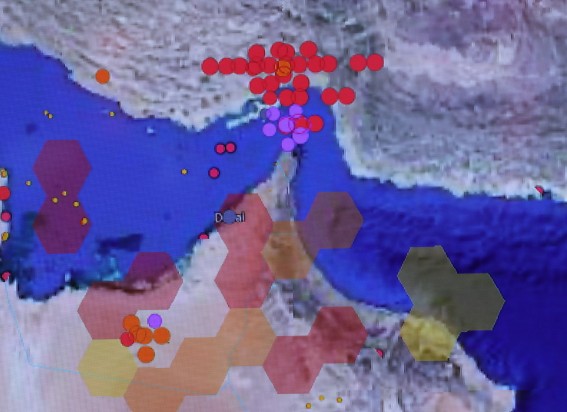
According to data cited in recent reports, more than 80% of vessels crossing the Strait of Hormuz over the past two weeks have used the Omani route.
This is a significant development.
Ships that once feared ignoring Iranian demands are becoming increasingly willing to use a route strongly opposed by Tehran, relying on promises of protection from U.S. naval forces.
In other words, Iran can still issue threats, but it appears increasingly less capable of forcing ships to comply with them.
That is the first sign of diminishing control.
Second: Washington Is Changing the Calculation of Fear
The United States does not need to “own” the Strait of Hormuz to weaken part of Iran’s influence.
It simply needs to convince shipping companies that their vessels can cross without submitting to Tehran’s conditions.
And that appears to be happening.
The substantial U.S. military presence in the region, surveillance of maritime traffic, and protection offered to commercial vessels have changed the calculations of shipping companies.
Previously, a tanker operator might have asked:
What will Iran do if we cross?
Now another question has emerged:
Can Iran stop us if U.S. forces are protecting us?
This psychological and strategic shift is crucial. Maritime control is not measured solely by the number of warships a country possesses. It is also measured by whose rules ultimately determine the behaviour of commercial vessels.
Third: Iran Is Losing the Transit-Fee Card
There is another economic indication that Iranian influence may be weakening.
During earlier stages of the crisis, Tehran was able to impose transit fees on some vessels.
However, declining traffic along Iran’s preferred route and the movement of a significant portion of shipping toward the Omani route have made the enforcement of such fees increasingly difficult.
At this point, the loss of control becomes more than a military issue. It becomes a financial and political loss.
The transit fees were never only about money. They also carried a message:
“If you want to pass, you must deal with us.”
If vessels can cross without paying or complying with Iranian conditions, the opposite message becomes increasingly powerful:
Hormuz is no longer a gateway whose terms Iran alone can dictate.
Fourth: Gulf Tankers Have Found a Way Through
Saudi Arabia, the UAE, and Kuwait have not waited for a political settlement.
According to the report, these countries chartered Very Large Crude Carriers (VLCCs) to transport oil out of the Gulf through Hormuz before transferring shipments to customers’ tankers outside the danger zone in the Gulf of Oman.
Even more strikingly, some tankers reportedly switched off their tracking systems for extended periods to reduce the risk of being targeted.
This is known as “dark shipping.”
A tanker may disappear from conventional commercial tracking screens while continuing to transport oil.
This development weakens one of Iran’s most important instruments of pressure: the assumption that disrupting Hormuz will automatically disrupt Gulf oil exports.
The more governments and companies develop ways to keep oil moving, the less effective Iran’s threat becomes.
Fifth: The Number That Should Worry Tehran — 15 Million Barrels
Perhaps the most concerning figure for Iran is not the number of American warships in the region.
It is the amount of oil that is still moving.
According to U.S. figures cited in the report, approximately 15 million barrels of oil per day have either passed through the Strait or been rerouted, compared with roughly 20 million barrels per day before the war.
The difference remains substantial, demonstrating that conditions are far from normal.
But Tehran faces another problem: millions of barrels are still reaching international markets despite the conflict.
This raises a fundamental question.
If the purpose of using Hormuz as leverage is to restrict energy exports and increase the global economic cost of confronting Iran, what happens to that leverage when oil continues to find a way through?
Every barrel that passes despite Iranian threats weakens, at least marginally, Iran’s deterrent power.
Does This Mean the United States Controls Hormuz?
No.
This distinction is essential if the situation is to be understood beyond political rhetoric.
Saying that Iran is losing control does not mean that the United States has gained complete control.
Continued attacks, dark shipping, the need for military protection, and the fact that oil flows have not fully returned to pre-conflict levels all demonstrate that Hormuz remains an extremely dangerous area.
Iran still possesses the ability to threaten, disrupt, and increase the cost of passage.
But there is an important difference between having the ability to inflict damage and having the ability to impose control.
And it is precisely the latter that Tehran appears to be losing.
From Control to Deterrence
Perhaps the best way to describe the emerging situation is that Iran is moving from control toward deterrence.
Control means being able to determine who passes, how they pass, and under what conditions.
Deterrence means being able to make passage dangerous and expensive without necessarily being able to prevent it.
That is an enormous strategic difference.
If 80% of vessels can choose a route Iran opposes, Gulf tankers can continue moving millions of barrels, and Washington can provide enough protection to keep maritime traffic flowing, then Tehran is no longer the only power setting the terms in the Strait.
Oman Moves to the Centre of the Conflict
Amid the confrontation between Washington and Tehran, another player is rapidly gaining importance: Oman.
The movement of a large share of shipping toward the Omani route gives Muscat growing strategic weight.
More importantly, Oman and Iran are holding discussions concerning the restoration of freedom of navigation without direct U.S. participation.
This places Oman at the centre of two equations simultaneously: as the location of a relatively safer maritime route and as a potential mediator capable of reducing tensions.
The growing Omani role may ultimately prove to be one of the most important geopolitical consequences of the crisis.
What Is Iran Actually Losing?
Tehran’s biggest potential loss is not a few million dollars in transit fees.
It is the declining strategic value of Hormuz as an instrument of leverage.
For years, simply threatening to close the Strait was enough to create anxiety in global oil markets.
Iranian deterrence rested on a simple equation:
If Iran is economically or militarily squeezed, it can make the rest of the world pay a price.
But that equation depends on one essential condition: the world must believe that Iran can actually disrupt the Strait.
If vessels continue crossing, oil continues flowing, military protection expands, and alternative arrangements become increasingly effective, markets may eventually begin treating the Iranian threat as a manageable risk rather than a weapon capable of paralysing global energy trade.
That is where the real loss begins.
But the Battle for Hormuz Is Not Over
Despite these developments, declaring Iran defeated in the Strait would be premature.
A major attack on a single tanker, a sudden military escalation, or a successful series of attacks against commercial vessels could quickly restore fear to global markets.
Hormuz is narrow, while the volume of energy moving through it is enormous. As a result, the ability to destabilize the area carries an impact far greater than its geographical size might suggest.
Iran may have lost part of its control, but it has not lost its ability to make the Strait dangerous.
That may be the greatest risk of the current situation.
Conclusion: Iran Is Not Losing Hormuz Geographically — It Is Losing Its Ability to Set the Rules
What is happening in the Strait of Hormuz is not a transfer of ownership or control from Iran to the United States.
It is something more complicated.
Iran is gradually losing its ability to make its will the determining factor in how vessels move through the Strait.
Ships are shifting toward the Omani route.
U.S. protection is encouraging vessels to continue crossing.
Gulf states are developing new ways to keep their oil moving.
Iran’s ability to impose transit fees is becoming more difficult.
And millions of barrels are still reaching international markets.
Together, these developments explain how a country can lose part of its control without losing its military capability.
The real test, therefore, will not be found in statements from Washington or Tehran. It will come down to one question:
When the next tanker enters the Strait of Hormuz, whose orders will it fear more?
The answer may ultimately determine who holds real influence over one of the world’s most important oil arteries.
Economic Unit – North America Office
Al-Rawabit Center for Research and Strategic Studies