
By : Shatha Kalel
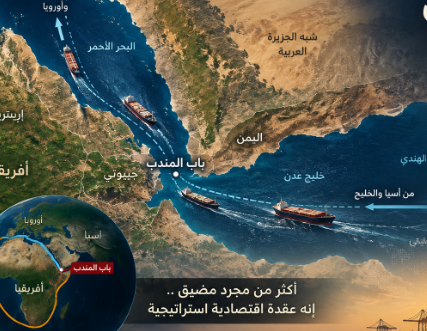
Bab el-Mandeb encapsulates, within its narrow geographical space, one of the most striking paradoxes of the global economy: a confined maritime passage capable of influencing trade flows that stretch across continents and distant markets. Located between Yemen on one side and Djibouti and Eritrea on the other, the strait forms the southern gateway to the Red Sea, connecting the Gulf of Aden and the Indian Ocean with the Red Sea and, through the Suez Canal, with the Mediterranean and Europe. This geography has made Bab el-Mandeb an essential part of the maritime corridor linking Asia, the Gulf, and Europe, particularly because maritime transport remains the backbone of international trade. The importance of Bab el-Mandeb does not lie in the complete absence of alternative routes, but rather in the fact that those alternatives are longer, slower, and more expensive. When passage through the strait and the Red Sea becomes dangerous, vessels can reroute around the Cape of Good Hope in southern Africa, but doing so adds considerable distance and travel time, increases fuel consumption, and raises operating and insurance costs. This is where geography becomes a source of power. The strait neither produces oil nor manufactures goods, yet it lies directly along the route through which a significant share of them reaches global markets. Yemen’s position overlooking both the Red Sea and the Gulf of Aden, together with Perim Island in the heart of the strait and other strategically located islands and maritime positions, gives the area significance far beyond the borders of any single state. Competition over coastlines, ports, and islands in the Red Sea therefore cannot be understood solely in military terms. It is also a competition for proximity to one of the world’s most important arteries of trade and energy, and for the ability either to safeguard maritime traffic or influence the level of risk surrounding it.
Economically, the greatest danger lies in the fact that influencing Bab el-Mandeb does not necessarily require completely closing the strait. The global economy prices not only actual disruption, but also risk. As soon as the probability of attacks on vessels or disruption to navigation rises, insurers begin increasing the cost of maritime coverage, shipping companies reassess their routes, and some vessels may divert to longer but safer alternatives. This sets off a chain of additional costs: greater risk means higher insurance premiums; rerouting means more fuel, time, and operating expenses; higher transportation costs affect importers and supply chains and can ultimately be passed on to consumers through higher prices. Economic control over Bab el-Mandeb should therefore be understood more broadly than conventional military control. An actor capable of changing the security environment surrounding the passage can indirectly influence the cost of using it. In this sense, real power lies not only in the ability to prevent a vessel from passing, but also in the ability to make its passage more expensive. Disruptions in the Red Sea have demonstrated this relationship in practice, as shipping companies have rerouted vessels around Africa while the economic consequences have extended far beyond the immediate area of confrontation. Egypt provides one of the clearest examples, as reduced traffic through the Red Sea has affected Suez Canal activity and the foreign-currency revenues associated with it. The Bab el-Mandeb crisis therefore demonstrates that maritime chokepoints are no longer simply transportation routes; they have become integral to the pricing of risk across the global economy. A security crisis in a small maritime corridor can translate into additional costs for an Asian factory, a European port, the budget of a state dependent on transit revenues, or the bill paid by a consumer who may not even know where the strait is located.
Strategically, Bab el-Mandeb cannot be viewed separately from the Strait of Hormuz and the Suez Canal. These waterways constitute interconnected links in the system that transports energy and goods between the Gulf, Asia, Africa, and Europe. This interdependence magnifies the strategic importance of Bab el-Mandeb. If the Strait of Hormuz comes under security pressure, alternative energy routes and infrastructure leading toward the Red Sea become increasingly important. Yet if Bab el-Mandeb is simultaneously disrupted, the available alternatives narrow and the economic cost of manoeuvring rises for both governments and corporations. Strategic power in the twenty-first century, therefore, is measured not only by the size of a country’s oil reserves or the number of ships and military bases it possesses, but also by its ability to secure—or influence—the critical nodes of global transportation and to maintain viable alternatives when those nodes are disrupted. From this perspective, sustained international attention to the Red Sea and the Gulf of Aden becomes understandable: protecting navigation through these waters means protecting part of the logistical infrastructure upon which the global economy depends. The central question, therefore, is not simply who controls Bab el-Mandeb? Rather, it is who can influence its security, who can absorb the economic cost of its disruption, and who possesses a viable alternative when passage through it becomes economically unsustainable? At this point, control evolves from a purely geographical concept into a far more complex economic and strategic one. A power does not need to control every vessel passing through the strait in order to exercise influence; it may be enough to possess the capacity to alter the risk calculations of shipping companies, insurers, and governments. Bab el-Mandeb thus represents a concentrated example of the relationship between geography, economics, and power: whoever can influence the security of the route can influence its cost, and whoever can influence its cost possesses a potential instrument of leverage over the trade that passes through it. Bab el-Mandeb may appear narrow on the map, but its true boundaries become remarkably wide when measured by the markets, energy flows, supply chains, and strategic interests affected by what happens within and around it.
Economic Studies Unit / North America Office
Al-Rabet Center for Research and Strategic Studies