
BY: Shatha kalel
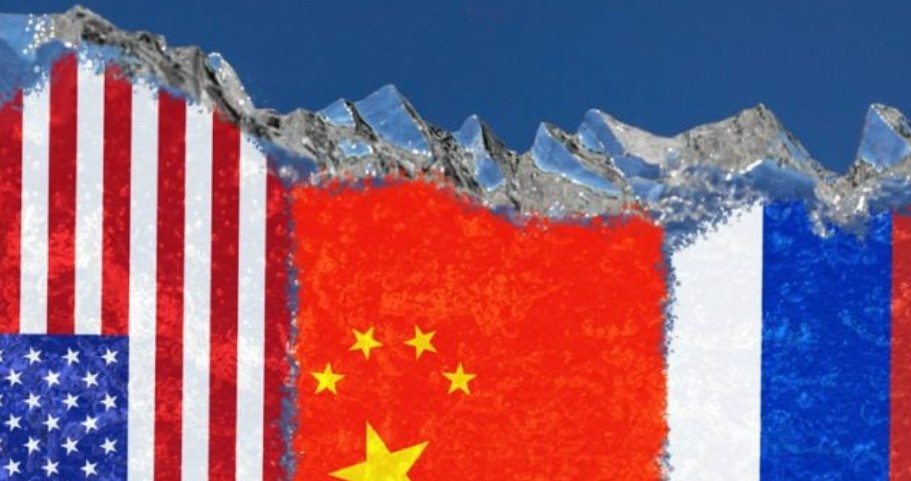
The world is no longer living through a period of traditional political rivalry between major powers. Instead, it has entered the most dangerous strategic and economic phase since the end of the Cold War. The ongoing struggle between United States, China, and Russia is no longer just about diplomatic disagreements or ordinary competition for influence. It has evolved into a massive historical battle aimed at reshaping the global order and determining who will lead the world in the coming decades.
Today, the world stands at a turning point similar to the major transformations that changed the course of history in previous eras. Each country within this “global triangle” is trying to impose its own vision for the future international system, while technology, energy, economics, and even currencies are increasingly becoming tools of power and conflict as dangerous as armies and missiles.
After the collapse of the Soviet Union in 1991, the United States emerged as the single dominant global power. Washington succeeded in expanding its influence over the global economy, while the U.S. dollar became the dominant currency in international trade and financial markets. Western-led financial institutions gained enormous influence over global economic decision-making. American dominance was not limited to economics alone; it also extended to military, technological, and political superiority, leading many to believe that the twenty-first century would become an “American century” without serious challengers.
However, what Washington failed to fully recognize at the time was that the world was quietly changing. While the United States was engaged in long and costly wars in the Middle East, China was steadily building one of the greatest economic powers in modern history. China did not rely on direct military wars to expand its influence. Instead, it used trade, industry, investment, and technology as tools for global expansion. Within a few decades, China transformed itself from a poor country dependent on cheap labor into the world’s second-largest economy and the largest industrial and commercial center on Earth.
Today, China is no longer merely “the factory of the world.” It has become a technological superpower competing with America in artificial intelligence, advanced industries, clean energy, and space technology. Beijing fully understands that economic control eventually translates into political power. Therefore, China seeks to build a vast global network of influence through enormous economic and investment projects stretching across Asia, Africa, and Europe. This is precisely why the United States fears that China’s rise may become a direct threat to American economic and technological dominance.
Meanwhile, Russia views the world from an entirely different perspective. Moscow believes that the West exploited the collapse of the Soviet Union to expand militarily and politically at Russia’s expense. Russia argues that the United States attempted to impose a unipolar world order in which other nations would remain subordinate to Washington’s decisions. As a result, Russia has spent recent years trying to restore its global influence through military power, energy resources, and political alliances.
Russia possesses one of the largest nuclear arsenals in the world, giving it enormous strategic weight in international confrontations. The Russian military remains among the world’s largest and most advanced armed forces, particularly in missile and strategic capabilities. In addition, Moscow relies heavily on its influence in the energy sector. Russia is one of the world’s largest exporters of oil and natural gas, and it uses energy as a tool of political and economic leverage, especially against Europe, which depends significantly on Russian energy supplies. At the same time, Russia seeks to expand its alliances with various countries and powers in an effort to weaken Western dominance and promote what it views as a more balanced international system.
Yet the real battle between these major powers is no longer centered solely on armies and weapons. Today, the struggle revolves around economics, technology, and energy. In the modern world, economic power can be more dangerous than missiles because countries that control markets, banks, and currencies can influence entire economies without firing a single shot.
This is why the United States uses the dominance of the U.S. dollar and the global financial system to impose massive sanctions on its rivals, while China and Russia attempt to reduce dependence on the dollar by promoting local currencies and building alternative economic and financial systems. The conflict is not merely about money itself, but about who controls the movement of the global economy.
Technology has also become the most dangerous weapon of the modern era. Any country that dominates artificial intelligence, semiconductor production, cybersecurity, and satellite systems will not only control the economy but will also gain enormous military and informational superiority. For this reason, the United States has imposed strict restrictions on Chinese technology companies, fearing that China could become the world’s leading technological power in the coming years.
At the center of this conflict remains energy and oil, which continue to form the backbone of the global economy. The world still relies heavily on oil and gas to sustain industries and economic growth. Consequently, regions such as the Arabian Gulf, the Strait of Hormuz, the South China Sea, and Ukraine have become highly dangerous geopolitical flashpoints because controlling these areas means directly influencing global energy prices and economic stability.
The world is increasingly anxious because this conflict does not resemble traditional wars of the past. It is a long-term and deeply complex struggle that could last for decades and affect nearly every aspect of life, from oil and food prices to currencies, employment, investments, and global economic stability. Any major confrontation between these powers could shake the world economy within hours.
Although all sides are attempting to avoid a direct military war due to their nuclear capabilities, the real danger lies in economic wars, cyber warfare, technological conflicts, and strategic competition that may ultimately have consequences even more destructive and long-lasting than conventional wars.
The Middle East has also become a central arena within this global conflict because the region contains some of the world’s most important energy resources and maritime trade routes. As a result, every major power seeks to strengthen its political, economic, and military influence across the region, while Middle Eastern countries attempt to maintain a delicate balance among these competing powers in order to avoid becoming direct battlegrounds.
In the end, what is happening today is not simply a temporary political disagreement between powerful nations. It is a historic struggle to rewrite the rules of the world itself. The United States seeks to preserve its global dominance, China aims to lead the coming economic century, and Russia is determined to break the Western-led order and restore its status as a great power.
As a result, the world is entering a new era defined by one fundamental reality:
“Whoever controls the economy, technology, and energy… controls the future of the world.”
Economic Studies Unit – North America Office
Center for Linkage Studies and Strategic Research