
An Economic Analysis of the US–China–Russia Understanding, Its Implications for Global Energy Markets and International Trade, and the Outlook for the Coming Months
BY: Shatha kalel
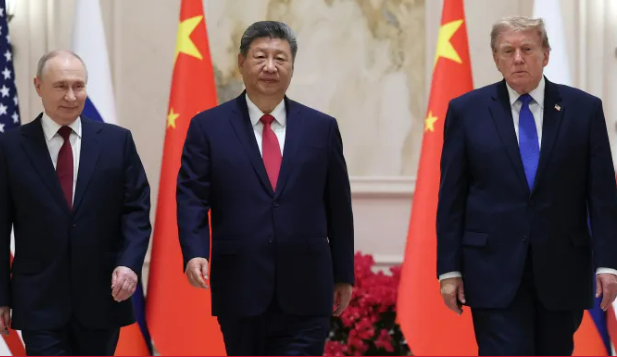
The trilateral summit bringing together US President Donald Trump, Chinese President Xi Jinping, and Russian President Vladimir Putin in Shenzhen, China, represents a significant development in international economic relations. Its importance extends beyond the historic nature of the meeting, particularly as it takes place during a period marked by geopolitical uncertainty, disruptions in global energy markets, and growing concerns about the future of international trade.
According to the information released, the three leaders committed to maintaining stable energy flows as part of what has been described as a peace declaration. This development raises an important economic question: Does the understanding represent the beginning of a new framework for cooperation among major powers, or is it primarily an attempt to contain the economic consequences of ongoing geopolitical conflicts?
Energy security appears to be one of the few areas where the economic interests of Washington, Beijing, and Moscow converge. The United States has a strong interest in limiting inflationary pressures associated with rising oil prices, particularly because higher energy costs affect household spending, industrial production, and monetary policy. China, as one of the world’s largest energy importers, depends heavily on reliable oil and gas supplies to maintain industrial activity, support exports, and sustain economic growth. Russia, meanwhile, relies significantly on energy export revenues to support its economy and public finances, especially amid Western sanctions and the continuing economic burden of the war in Ukraine.
This convergence of interests suggests that energy stability could provide a practical foundation for limited cooperation, even if broader strategic disagreements remain unresolved.
From a market perspective, the summit could contribute to reducing the geopolitical risk premium embedded in international oil prices. If investors believe that the three powers are committed to preventing major disruptions in energy supplies, market volatility may gradually decline. However, diplomatic declarations alone are unlikely to produce lasting stability without concrete measures addressing maritime security, trade restrictions, production continuity, and transportation risks.
Developments involving Iran and the Strait of Hormuz remain particularly important. Any disruption to shipping through this strategic passage could increase oil prices, insurance premiums, and transportation costs, creating additional inflationary pressures across importing economies. Conversely, a credible reduction in regional tensions could improve market confidence and ease some of the financial pressures affecting global supply chains.
The economic implications also extend to international trade. Relations between the United States and China continue to be shaped by tariffs, technological restrictions, competition over strategic minerals, and efforts to secure semiconductor supply chains. A sustained diplomatic understanding could provide businesses with greater predictability, encouraging investment and reducing uncertainty in international commercial transactions.
Nevertheless, neither Washington nor Beijing is likely to abandon its long-term strategy of strengthening technological independence and protecting critical industries. Russia may also seek to use the summit to expand economic partnerships and reduce its international isolation, although diplomatic engagement does not necessarily imply the removal of existing sanctions.
Looking ahead, three economic scenarios appear possible.
The first and most likely scenario involves limited economic stabilization. Diplomatic communication continues, major disruptions to energy supplies are avoided, and trade tensions remain manageable. Under these conditions, global markets could experience lower volatility without a comprehensive political settlement.
The second scenario involves broader economic cooperation. The three governments could develop practical arrangements concerning energy security, trade, and crisis management. Such developments might strengthen investor confidence, reduce shipping and insurance costs, and support international economic activity. However, this outcome would require clear commitments and measurable implementation mechanisms.
The third scenario involves renewed geopolitical escalation. If disagreements over Iran, Ukraine, sanctions, or technological competition intensify, the economic benefits of the summit could quickly disappear. Oil prices might rise, supply chains could face further disruption, and inflationary pressures could return, potentially weakening global growth.
Over the next three to six months, financial markets are likely to interpret the Shenzhen summit as a potentially positive signal rather than evidence of a fundamental transformation in international economic relations. The most important indicators will include actual energy supply conditions, developments in US–China trade negotiations, changes in sanctions policies, and the security situation in the Middle East and Ukraine.
Ultimately, the summit highlights a central reality of the global economy: economic interdependence continues to impose practical limits on geopolitical confrontation. Although the United States, China, and Russia maintain competing visions of the international order, all three share an interest in preventing severe disruptions to global economic stability.
The most plausible outcome is therefore not the emergence of a formal trilateral economic alliance, but a period of managed competition and selective cooperation. Whether this approach succeeds will depend on the ability of political leaders to translate diplomatic commitments into credible economic policies and practical agreements.
The future of global economic stability will be determined not simply by the declarations made in Shenzhen, but by the decisions taken in the months that follow.
Economic Studies Unit | North America Office
Al-Rawabet Center for Research and Strategic Studies