
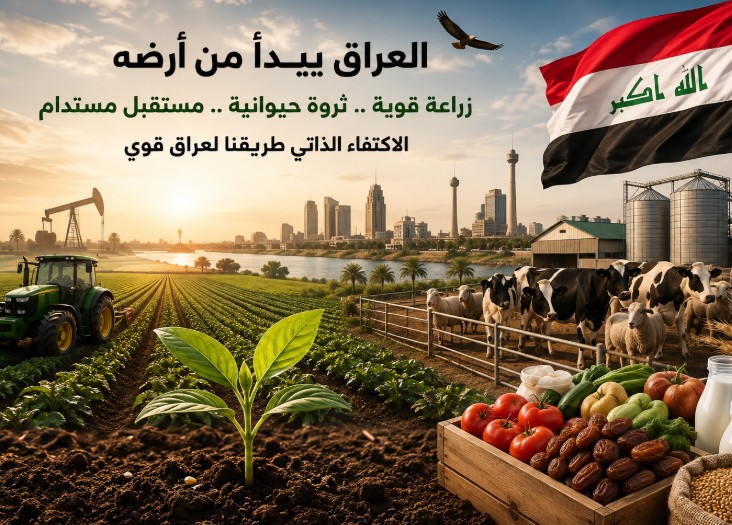
No country that has achieved comprehensive economic prosperity began its journey through industry or technology alone. Sustainable development has always started with the establishment of a strong agricultural sector capable of ensuring food security, stimulating rural economies, creating employment opportunities, and supplying raw materials for a wide range of industries. Agriculture is not merely the production of crops; it is the foundation of real economic production upon which all other productive sectors are built. This is why countries that have successfully achieved sustainable development, such as China, have invested heavily in modernizing agriculture and integrating it with industry, trade, and scientific research, recognizing that a strong economy begins with strong domestic production.
For Iraq, revitalizing the agricultural sector can become the true starting point for building a more diversified and resilient economy, particularly in light of the country’s heavy dependence on volatile oil revenues. Investment in agriculture is not simply about increasing food production; it is about activating an extensive economic value chain that extends from farms to processing industries and ultimately to domestic and international markets.
One of the most immediate benefits of agricultural development is the creation of large-scale employment opportunities. Agriculture has the capacity to absorb significant numbers of farmers while also creating jobs for young people, university graduates, and women in rural communities. As agricultural production expands, demand also grows for agricultural engineers, veterinarians, technicians, machine operators, logistics specialists, marketing professionals, and business managers. Consequently, agricultural development contributes to reducing unemployment while promoting balanced social and economic development.
The importance of agriculture extends far beyond primary production. It serves as the driving force behind food-processing industries that depend on agricultural and livestock products as raw materials. Increased milk production stimulates the growth of dairy processing plants producing milk, cheese, yogurt, and other dairy products. Expansion of livestock production supports meat processing, food preservation, leather manufacturing, and wool industries. Likewise, greater production of grains, dates, fruits, and vegetables encourages investment in flour mills, vegetable oil factories, food-processing facilities, and feed manufacturing plants. In this way, agriculture evolves from a primary sector into a major engine of industrial development, increasing the value added of domestic products and strengthening the contribution of the non-oil economy to Iraq’s Gross Domestic Product (GDP).
Another major economic benefit of agricultural development is reducing dependence on imported food. Iraq spends billions of dollars every year importing wheat, vegetables, fruits, meat, dairy products, and other essential food commodities. This represents a continuous outflow of foreign currency that could otherwise be invested in domestic development. As local agricultural production expands and satisfies a larger share of national demand, food imports decline, financial resources remain within the national economy, the trade balance improves, and the country’s economic security is strengthened.
Agriculture also supplies the essential raw materials required by the industrial sector, an aspect that is often overlooked in discussions of economic development. Manufacturing industries cannot operate efficiently without reliable domestic sources of raw materials. Dates support the food-processing industry, cotton supplies textile manufacturing, grains form the backbone of food industries, while dairy and meat processing depend on locally produced livestock. The greater the availability of these inputs within Iraq, the lower the production costs for manufacturers and the greater their ability to compete in both domestic and international markets.
A thriving agricultural sector also raises income levels in rural areas, directly improving living standards and reducing poverty. When farmers earn stable and profitable incomes from their land, they are better able to invest in education, healthcare, housing, and improved agricultural technologies. Higher rural incomes also stimulate commerce and service activities in villages and district centers. As a result, rural development helps reduce migration to major cities, easing pressure on urban infrastructure and public services in Baghdad and other large urban centers.
Agricultural development also plays a crucial role in strengthening food security and stabilizing food prices. Excessive dependence on international markets exposes countries to fluctuations in global prices, geopolitical tensions, supply chain disruptions, and natural disasters. By establishing a strong domestic agricultural base, Iraq can ensure a more reliable food supply for its population while maintaining greater price stability, even during periods of international economic uncertainty.
The economic impact of agriculture extends well beyond farms and food factories. It stimulates transportation, storage, marketing, veterinary services, logistics, and quality-control industries. Every ton of agricultural produce requires transportation networks, cold-storage facilities, grading and packaging centers, wholesale markets, distribution companies, and food safety inspection services. Likewise, livestock production depends on advanced veterinary care, diagnostic laboratories, feed manufacturing plants, and modern slaughterhouses. Consequently, agricultural development activates an extensive value chain that creates thousands of employment opportunities outside the farm itself.
Finally, investment in agriculture promotes balanced regional development across Iraq’s provinces. Economic activity remains heavily concentrated in Baghdad and a limited number of major cities, despite the vast agricultural resources available throughout the country’s other governorates. Establishing agricultural projects and food-processing industries in provinces such as Nineveh, Anbar, Diyala, Wasit, Basra, Dhi Qar, and Al-Muthanna would distribute economic activity more evenly, reduce regional development disparities, and contribute to greater social and economic stability.
Therefore, agriculture should no longer be viewed simply as the process of cultivating land and harvesting crops. In today’s economy, agriculture represents a comprehensive production system that begins with scientific research, seed improvement, and livestock breeding, continues through agricultural production and extension services, and extends to food processing, packaging, storage, transportation, marketing, and export. Building a modern agricultural sector should therefore be regarded as one of the fundamental pillars of Iraq’s national development strategy. Such an approach would diversify the economy, reduce dependence on oil revenues, establish a productive economic base capable of generating sustainable growth, create employment opportunities, and strengthen the country’s long-term food security.
Economic Unit – North America Office
Al-Rawabit Center for Research and Strategic Studies