
As the UK government prepares to decide the future of one of its largest untapped oil fields, the Rosebank project has become a major test of energy security, economic investment, employment, and environmental policy.
A Critical Decision for Britain’s Energy Sector
The Rosebank oil field, located approximately 80 miles northwest of Shetland in the North Atlantic, has emerged as one of the United Kingdom’s most controversial energy developments.
The debate has intensified following the government’s decision to approve gas production from the Jackdaw field in the North Sea. Attention has now shifted to Rosebank, a substantially larger development with potentially greater economic returns and higher greenhouse gas emissions.
Energy Secretary Miatta Fahnbulleh faces a decision that could shape the future of Britain’s offshore oil and gas industry.
Owned by Adura and Ithaca, Rosebank is estimated to contain between 300 million and 500 million barrels of oil and could remain productive for approximately 25 years.
For its supporters, the project represents an opportunity to strengthen domestic energy production, protect skilled employment, and generate tax revenues. For environmental campaigners, it represents a costly expansion of fossil fuel production at a time when Britain is seeking to accelerate its transition toward renewable energy.
The Economic Significance of Rosebank
Rosebank’s economic importance extends beyond its substantial oil reserves.
The field also contains natural gas that could be transported through pipelines to Shetland and onward to the St Fergus terminal in Aberdeenshire.
According to Neil McCulloch, chief executive of Adura, the gas produced at peak output could potentially meet the heating needs of approximately 500,000 British homes.
Adura, which holds an 80% interest in Rosebank, is a joint venture between Shell and Norway’s state energy company Equinor.
Supporters argue that the project could generate significant tax revenues for the UK Treasury while supporting offshore engineering, maintenance, transportation, and associated supply-chain activities.
However, the distribution of these economic benefits remains contested.
Oil extracted from Rosebank would be transferred to tankers and sold on international markets, with much of it potentially transported to continental Europe for refining.
Environmental opponents argue that this limits the project’s direct contribution to Britain’s domestic energy security.
Industry representatives counter that British and European energy markets are closely interconnected, meaning that increased regional production can still contribute to broader energy supply stability.
Jobs, Skills, and Offshore Investment
The Rosebank development also highlights the employment dimension of Britain’s energy transition.
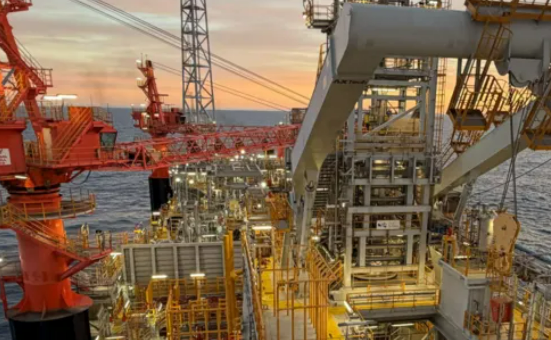
The Petrojarl Rosebank, a floating production, storage and offloading vessel (FPSO), currently accommodates approximately 122 workers.
The vessel operates in one of the world’s most challenging offshore environments, where severe weather, powerful ocean swells, and remote working conditions require specialized engineering expertise.
Workers describe offshore employment as financially rewarding, supported by accommodation, recreational facilities, and rotational working schedules.
Nicola Boyd, who manages helicopter deck operations, works two weeks offshore followed by three weeks of leave.
Production supervisor Douglas Hogge believes that approval of Rosebank could provide long-term employment opportunities, potentially extending to retirement for some workers.
These perspectives illustrate a central economic challenge facing the UK: how to protect skilled employment and industrial expertise while gradually reducing dependence on fossil fuels.
The broader industry has been declining for decades. UK oil production peaked approximately 25 years ago, and employment losses in oil and gas have recently exceeded job creation in renewable energy sectors such as wind and solar power.
This raises important questions about the pace of the energy transition and whether alternative industries can absorb workers leaving traditional energy production.
Environmental Concerns and Legal Challenges
Despite its potential economic benefits, Rosebank faces substantial environmental opposition.
The project initially received government approval in 2023 under the Conservative administration.
However, in 2025, following legal challenges brought by Greenpeace and Uplift, Scotland’s Court of Session ruled that the approvals for Rosebank and Jackdaw were unlawful.
The court found that the environmental assessments had failed to account adequately for emissions generated when the extracted oil and gas would eventually be burned.
Developers were permitted to continue preparatory work but could not begin production without further regulatory approval.
Tessa Khan, executive director of Uplift, argues that expanding fossil fuel production would worsen climate change while directing substantial profits toward already profitable energy companies.
She maintains that the UK should prioritize renewable energy investment as part of its broader industrial development strategy.
The disagreement reflects a fundamental policy question: should Britain continue developing its remaining offshore oil and gas reserves, or redirect investment toward cleaner energy technologies?
Could Rosebank Trigger Further Development?
The government’s decision may have implications extending beyond Rosebank itself.
According to Adura’s chief executive, approval could encourage development of four additional gas prospects west of Shetland: Tornado, Tornado East, Tobermory, and Suilven.
Each could potentially represent a development comparable in scale to Jackdaw.
For energy companies, this creates opportunities for further investment and commercial activity.
For environmental campaigners, however, it raises concerns about a longer-term expansion of fossil fuel infrastructure and emissions.
The outcome could therefore influence investor expectations and future decisions about capital allocation within Britain’s offshore energy sector.
The Challenge of Balancing Energy Security and Climate Policy
Rosebank illustrates the difficult economic choices facing governments during the transition to lower-carbon energy systems.
Domestic oil and gas production may provide employment, tax revenues, and additional energy supplies, but these benefits must be weighed against environmental costs, long-term market trends, and climate commitments.
The economic argument is further complicated by the international nature of oil markets.
Additional British production does not necessarily translate into proportionately lower domestic energy prices, because oil is traded globally and prices are influenced by international supply and demand.
Similarly, the long-term profitability of offshore projects depends on future energy prices, production costs, taxation, and regulatory conditions.
Government decisions must therefore consider not only immediate investment and employment benefits but also the possibility of changing demand for fossil fuels over the coming decades.
Conclusion: A Decision Beyond One Oil Field
The future of Rosebank represents more than a regulatory decision concerning a single offshore development.
It is a test of how Britain intends to balance economic growth, energy security, industrial employment, investor confidence, and environmental responsibility.
For the oil and gas industry, approval could provide an important signal that additional offshore investment remains possible.
For climate campaigners, rejection would demonstrate a stronger commitment to reducing future fossil fuel production.
Yet neither outcome eliminates the broader economic challenge of managing the transition away from an industry that has supported British employment, public revenues, and engineering expertise for generations.
Ultimately, the Rosebank decision will reveal not only the direction of Britain’s energy policy but also how the government intends to reconcile the economic value of its remaining oil and gas resources with the financial and environmental demands of a changing global energy system.
BBC