
By :Shatha Kalel
Donald Trump’s latest approach to the Korean Peninsula should not be viewed simply as another attempt to negotiate with North Korea. It is part of a much larger transformation in the way the United States manages its alliances—and that transformation could have consequences far beyond Korea.
For decades, the security architecture of East Asia rested on a relatively simple bargain. The United States provided the military power and extended its security umbrella over allies such as South Korea and Japan. In return, those allies remained closely aligned with Washington politically, economically and strategically.
President Donald Trump is challenging that model.
His approach is more transactional. He increasingly asks what American allies contribute to US security and economic interests, rather than treating alliances as permanent obligations regardless of the circumstances. The reduction of the annual Ulchi Freedom Shield military exercise in South Korea is therefore significant not only because of the exercise itself, but because of the message it sends about the future of the US alliance system.
The deeper question is this:
What happens to East Asia when America’s allies begin preparing for a future in which Washington may be less predictable?
The answer could be a major redistribution of military, economic and diplomatic power across the region.
From Alliance Certainty to Transactional Security
The traditional US-South Korea alliance was built around deterrence. The presence of American forces, military exercises and the promise of US support were designed to convince North Korea that an attack would be extremely costly.
Trump’s approach introduces a different calculation.
Rather than treating American protection as an unconditional strategic commitment, Trump has repeatedly emphasized burden-sharing. South Korea is expected to contribute more to its own defence and, more broadly, to support US strategic objectives.
From Trump’s perspective, this is not necessarily a rejection of alliances. It is an attempt to make them more useful to the United States.
The problem is that deterrence depends not only on military capability but also on credibility.
North Korea does not need to believe that America has abandoned South Korea completely. It only needs to believe that there is greater uncertainty about what Washington would actually do in a crisis.
That uncertainty can change the calculations of every government in the region.
If Seoul doubts American reliability, it will naturally invest more in independent defence. If Tokyo sees the same uncertainty, it may accelerate its military transformation. If Beijing concludes that the American alliance system is weakening, it may see an opportunity to expand Chinese influence.
In this sense, Trump’s policy could produce consequences that go well beyond what Washington intends.
South Korea: From Protected Ally to Strategic Actor
South Korea is no longer the relatively weak country it was when the US alliance was established.
It is now a major industrial and technological power with world-class companies in semiconductors, automobiles, batteries, shipbuilding and advanced manufacturing.
That creates an important paradox.
South Korea remains heavily dependent on the United States for security, but it possesses far greater economic and technological resources with which to build its own defence capabilities.
If uncertainty about Washington continues, Seoul could increasingly conclude that it needs to become a more autonomous military power.
This does not necessarily mean abandoning the US alliance.
A more likely outcome is alliance diversification: South Korea could remain closely connected to Washington while simultaneously building greater independent military capabilities and maintaining economic relations with Beijing.
That strategy would give Seoul more freedom of action, but it would also make South Korea a more independent geopolitical actor.
The long-term question is whether Washington is comfortable with an ally that becomes strong enough to make more of its own strategic decisions.
The Nuclear Question
The most difficult issue remains North Korea’s nuclear weapons.
For years, US policy has been built around the objective of denuclearisation. North Korea, however, increasingly treats its nuclear arsenal as the foundation of regime survival.
This creates a fundamental mismatch.
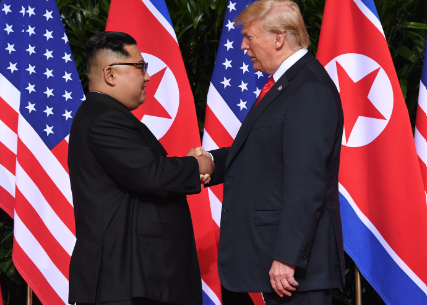
Trump may believe that personal diplomacy with Kim Jong Un can reduce tensions. His previous meetings with Kim demonstrated that direct communication between the two leaders is possible.
But diplomacy and denuclearisation are not the same thing.
A summit could produce agreements on military exercises, communication channels, sanctions or crisis management without persuading North Korea to surrender its nuclear weapons.
That possibility raises an uncomfortable strategic question:
Would Washington eventually move from trying to eliminate North Korea’s nuclear weapons to managing a permanently nuclear North Korea?
Such a shift would fundamentally change East Asian security.
If North Korea’s nuclear status becomes accepted in practice, South Korea and Japan could face greater pressure to develop stronger independent deterrence capabilities.
That could create an arms race that would be difficult to reverse.
China’s Opportunity—and Its Problem
China has an enormous stake in the future of the Korean Peninsula.
Beijing does not want a major war on its border. It also does not want North Korea to collapse, creating instability and potentially bringing US-allied forces closer to China’s frontier.
At the same time, China wants to prevent South Korea and Japan from becoming even more deeply integrated into a US-led strategic coalition.
Trump’s transactional approach therefore creates both an opportunity and a danger for Beijing.
The opportunity is obvious: if South Korea becomes less confident in Washington, Beijing can offer economic and diplomatic alternatives.
China’s economic relationship with South Korea gives it significant leverage. Trade, technology, manufacturing and supply chains create incentives for Seoul to maintain a working relationship with Beijing.
But China’s problem is equally important.
If US uncertainty causes Japan and South Korea to become more militarily independent, China could face stronger neighbours rather than weaker ones.
That is particularly important in the case of Japan.
Japan: The Unexpected Beneficiary?
One of the most interesting consequences of Trump’s approach could be the acceleration of Japan’s military transformation.
Japan has traditionally relied heavily on the US security alliance while maintaining substantial restrictions on its military role.
But the strategic environment is changing.
China is becoming more powerful. North Korea possesses nuclear weapons. Russia remains a military factor. And uncertainty about America’s future commitments creates another incentive for Tokyo to strengthen its own capabilities.
This does not necessarily mean Japan is preparing for war.
Rather, Japan is developing the capacity to act if American support becomes unavailable or insufficient.
That distinction matters.
A more capable Japan could strengthen regional deterrence and reduce the burden on the United States. But from Beijing’s perspective, the same development could look like the emergence of a major independent military competitor.
The irony is that a US policy intended to make allies more responsible for their own defence could eventually produce allies with greater strategic independence.
The Economic Battlefield
The transformation in East Asia is not only military.
It is also economic.
The most important competition increasingly involves technology, industrial capacity and control over strategic supply chains.
South Korea is central to this competition because of its dominance in semiconductors, batteries, electronics, shipbuilding and automobiles.
The United States wants Korean companies to invest more heavily in America and strengthen production inside the United States. Washington also wants to reduce strategic dependence on China.
China, meanwhile, wants to preserve its economic relationship with South Korea and prevent American pressure from pushing Korean companies entirely away from the Chinese market.
For South Korea, this creates a difficult economic calculation.
The United States offers access to a massive consumer market, advanced technology partnerships and an important security relationship.
China offers geographic proximity, enormous trade opportunities and integration into Asian supply chains.
Seoul therefore faces a choice that is not simply ideological.
It is a question of economic survival and strategic flexibility.
The likely answer may not be choosing Washington over Beijing or Beijing over Washington.
South Korea may instead attempt to remain economically connected to both while strengthening its own technological and military capabilities.
Tariffs and Investment: The Hidden Strategic Dimension
Trump’s economic policies also matter because tariffs and investment decisions can influence military power.
A country that controls advanced semiconductor production, shipbuilding capacity, battery technology and critical industrial supply chains possesses strategic power.
This means the US push to attract Korean investment is about more than creating American jobs.
It is also about bringing strategically important production into the American economic system.
Factories built in the United States can reduce supply-chain vulnerability, strengthen American industrial capacity and make Korean companies more deeply connected to the US economy.
For South Korea, however, moving production to America can create costs at home.
If Korean companies invest heavily overseas, South Korea may gain political access to the American market but potentially lose some domestic manufacturing capacity.
The result could be a new form of economic competition in which governments use tariffs, subsidies, investment agreements and national-security regulations to influence where companies build factories.
The boundary between trade policy and national security is disappearing.
The Risk of a Regional Security Dilemma
The most dangerous possibility is not necessarily that one country deliberately starts a war.
It is that every country responds defensively to what another country is doing.
South Korea strengthens its military because it fears North Korea.
Japan strengthens its military because it fears China and doubts America’s long-term reliability.
China strengthens its military because it fears Japan, the United States and regional containment.
North Korea expands its nuclear arsenal because it fears regime change and American military power.
The United States then responds to the growing military power of China and North Korea by strengthening its own position.
Each government can claim that its actions are defensive.
Yet collectively, the region becomes more heavily armed.
This is the classic security dilemma.
And it is one of the most important risks facing East Asia.
The Taiwan Factor
There is another issue that cannot be ignored: Taiwan.
The future of the US alliances with South Korea and Japan is closely connected to any potential conflict involving China and Taiwan.
Washington increasingly expects its allies to contribute to broader regional security, not simply to the defence of their own territories.
South Korea therefore faces a difficult question:
If a crisis erupts around Taiwan, would Seoul be expected to support the United States?
From Washington’s perspective, greater allied participation could strengthen deterrence against China.
From Seoul’s perspective, however, involvement in a Taiwan conflict could expose South Korea to economic retaliation from China while potentially leaving it more vulnerable to North Korea.
This explains why South Korea’s strategic autonomy is becoming increasingly important.
Seoul wants the ability to decide for itself how and when it becomes involved in regional conflicts.
The Real Contest: Who Defines the Rules?
The deeper struggle in East Asia is therefore not simply about North Korea.
It is about who gets to define the rules of the region.
For decades, the United States largely shaped those rules through its military alliances, economic influence and diplomatic network.
China is now powerful enough to challenge that structure.
Japan is becoming more strategically independent.
South Korea is becoming more capable and more cautious.
North Korea is attempting to use its nuclear capabilities to secure its position.
Trump’s policies are accelerating this process because they make America’s future role less predictable.
The result is not necessarily the end of American leadership.
Instead, it may be the beginning of a more contested regional order in which Washington remains extremely powerful but no longer has the same unquestioned influence over its allies.
Who Benefits—and Who Loses?
The short-term winners could include countries and companies that successfully adapt to the new environment.
The United States could benefit if allies invest more in American factories, defence and technology.
South Korea could benefit if it uses the competition between Washington and Beijing to increase its strategic leverage.
Japan could benefit from greater military and diplomatic independence.
China could benefit from greater economic influence if US credibility declines.
But there are also significant risks.
The biggest potential loser may be regional stability itself.
A more heavily armed East Asia could become more difficult to manage. Miscalculations could become more dangerous. Economic interdependence could be weaponised. And crises involving North Korea or Taiwan could rapidly become larger regional confrontations.
A New East Asian Order
The old East Asian order depended heavily on a simple assumption: the United States would remain the region’s dominant security power and would stand firmly behind its allies.
That assumption is now being questioned.
Trump did not create the rise of China, Japan’s military transformation, North Korea’s nuclear programme or South Korea’s desire for greater autonomy. These trends existed before him.
But his transactional approach is changing the speed and direction of the adjustment.
The central issue is therefore not whether Trump is “weakening” or “strengthening” the United States.
The more important question is whether his approach produces a stronger network of self-reliant allies or a less cohesive alliance system in which every country begins preparing for itself.
Those are very different outcomes.
If South Korea and Japan become stronger while remaining firmly connected to the United States, Washington could ultimately benefit. Its allies would carry more of the defence burden while the broader alliance network would remain intact.
But if uncertainty causes those countries to pursue completely independent strategic policies, the United States could lose some of the influence that made its alliance system so powerful in the first place.
For China, the same dilemma exists. A weaker US presence may create more room for Chinese influence, but a less predictable America could also encourage Japan and South Korea to become stronger military powers.
For North Korea, the opportunity is to preserve its nuclear status and gain diplomatic recognition. But greater uncertainty could also encourage South Korea and Japan to develop stronger deterrence.
Conclusion: The Beginning of a More Uncertain Asia
The Korean Peninsula is becoming the testing ground for a much larger geopolitical experiment.
Trump is asking whether alliances can be made more valuable to the United States through burden-sharing and economic reciprocity. South Korea is asking whether it can remain protected by America while gaining greater strategic independence. Japan is asking how much military responsibility it should assume. China is asking whether it can expand its influence without provoking a regional coalition against it. North Korea is asking whether its nuclear status can eventually become accepted as a permanent reality.
None of these questions has an easy answer.
But one conclusion is becoming increasingly difficult to avoid:
East Asia is moving from an era of relatively predictable American dominance toward a more competitive and uncertain regional order.
The future may not be defined by one dominant power.
Instead, it may be shaped by several strong states—each armed with greater military capabilities, deeper economic tools and stronger incentives to protect its own interests.
That could produce a healthier distribution of responsibility.
Or it could produce instability.
The outcome will depend on whether Washington, Beijing, Tokyo, Seoul and Pyongyang can manage their growing competition without allowing uncertainty to become confrontation.
The most important battle in East Asia may therefore not be the next military exercise or the next Trump-Kim summit.
It may be the struggle to determine what the rules of the region will be when the old rules no longer provide certainty.
Economic Unit – North America Office
Al-Rawabit Center for Research and Strategic Studies