
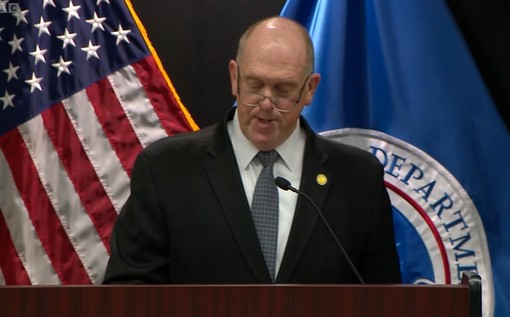
The US immigration enforcement surge in Minnesota will end, President Donald Trump’s border tsar told reporters on Thursday.
Tom Homan said Trump had approved his request to conclude the operation, adding he would stay in Minnesota “a little longer to oversee the drawdown, to ensure its success”.
Homan said Operation Metro Surge had resulted in many illegal immigrants who had committed violent crimes being detained for deportation. But the surge also sparked nationwide protests when two US citizens, Renee Good and Alex Pretti, were killed by immigration officers.
After the news conference, top Minnesota and federal officials appeared at a Capitol Hill hearing on Trump’s immigration crackdown.
Officials in Minnesota have been able to “greatly reduce the number of targets” for immigration enforcement, Homan said, adding that Operation Metro Surge was a “great success”.
More than 4,000 undocumented immigrants had been arrested, according to Homan, including men he said were convicted of rape and other sexual misconduct.
Homan said Immigration and Customs Enforcement (ICE) has always had a presence in Minnesota and will continue to have one.
He said that the surge’s end came after an unprecedented level of cooperation between federal agents and local law enforcement, with local officials increasing their crackdown on protesters he called public safety threats and local jails more willing to notify ICE of the release dates for individuals it was seeking.
Minnesota Governor Tim Walz said at a news conference following Homan’s announcement that he was “cautiously optimistic” about the drawdown of federal agents.
“The fact of the matter is they left us with deep damage, generational trauma,” Walz said. “They left us with economic ruin in some cases. They left us with many unanswered questions.”
The governor is expected to soon propose a $10m (£7m) emergency fund for small businesses who say they were financially hurt by the surge.
Following the fatal shooting of Alex Pretti last month, President Donald Trump dispatched Homan to Minneapolis to oversee the surge, sidelining the operation’s leader, Greg Bovino, who had faced intense criticism for ICE’s use of force and what many in the city alleged were civil rights violations.
Trump’s immigration crackdown has faced resistance in Democrat-led cities like Minneapolis from activists in the streets and local officials and immigrants in the courts. The administration last month finished removing National Guard troops from Portland, Los Angeles and Chicago – places where there had been large protests against the presence of troops and immigration agents – according to US Northern Command.
Some Republicans, too, had questioned the Minneapolis operation.
Senator Rand Paul told a committee hearing with Department of Homeland Security (DHS) officials on Thursday that “saying we’re going to reduce this presence in the street is a good sign and a good step forward”.
“I’m glad that’s happening,” the Republican from Kentucky said. “I think that is de-escalation.”
ICE Acting Director Todd Lyons said at the hearing that the agency is tracking roughly 1.6 million undocumented immigrants with deportation orders in the US, including roughly 800,000 who have criminal convictions.
He also defended against accusations from lawmakers that the agency was not holding officers accountable, saying ICE had opened 37 open investigations for excessive use of force since January 2025.
The fight over how immigration agents operate has now put the federal government at risk of a partial shutdown as Congress debates a funding measure for the DHS, which includes ICE. If lawmakers do not pass the measure, the department, which also includes emergency assistance, will lose its funding starting Saturday.
Democrats are demanding changes in ICE – such as ending the wearing of masks – in exchange for support for the bill. They are also pushing for immigration agents in Minnesota and elsewhere to be required to reveal their identities and to end warrant-less searches.
BBC