
By: Shatha Kalel
After the US-led invasion in 2003, the United Nations Security Council adopted Resolution 1483, which called for protecting Iraq’s oil revenues and state assets from judicial seizure by creditors. At the time, Iraq faced massive financial claims related to war reparations, unpaid loans, and lawsuits linked to the era of Saddam Hussein’s regime.
To implement this protection in practice, US President George W. Bush issued Executive Order 13303, granting legal immunity to Iraqi oil revenues and government assets from legal action. This order was later renewed and amended, particularly in 2014, after Iraq settled a large portion of its historical debts, including those owed to Kuwait.
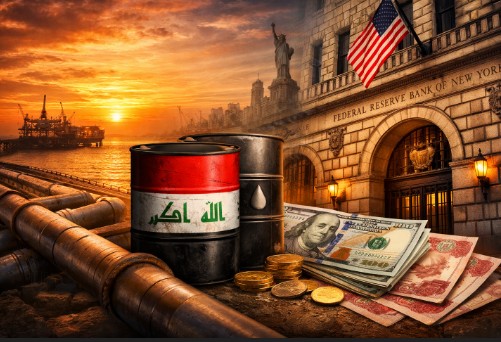
Economically, this arrangement meant managing oil revenues through protected accounts in New York, preventing creditors from seizing them before they entered the Iraqi state budget.
Economic advantages of this arrangement
Protection of revenues from creditors and financial shocks
When this mechanism was established, Iraq’s debt exceeded $120 billion. Without legal protection, courts anywhere in the world could have seized Iraqi oil revenues.
This system:
Prevented sovereign default.
Gave Iraq time to restructure its debts.
Preserved the state’s ability to pay salaries and fund essential services.
Exchange rate stability and dollar inflows
Oil accounts for about 90 percent of state revenues, while the Iraqi economy depends heavily on imports. Holding oil revenues in New York ensures a steady flow of dollars into Iraq, which:
Limits volatility in the dinar exchange rate.
Prevents balance-of-payments crises.
Provides stable financing for food and medical imports.
From this perspective, the system functions as an external monetary anchor for the Iraqi economy.
Strengthening international confidence and attracting investment
Under Federal Reserve oversight, oil revenues are less exposed to corruption or legal disruption, which:
Encourages global oil companies to invest.
Reduces insurance costs and legal risks.
Makes Iraqi oil one of the more attractive assets in high-risk environments.
The hidden economic costs
Incomplete financial sovereignty
Although Iraq is the legal owner of the funds, access to them is conditional on continuous monitoring and financial scrutiny. In practice:
Iraq cannot freely dispose of its revenues.
Transfers are subject to external approvals and audits.
Any political tension can quickly turn into direct financial pressure.
A powerful tool of economic pressure
Since salaries, imports, and the state budget depend on dollars coming from New York, any restriction on access to funds means:
Rapid economic paralysis.
Immediate social and political pressure.
This makes financial leverage more powerful than traditional sanctions or even military presence.
Weakening the development of an independent financial system
Long-term reliance on this mechanism has led to:
Fragility in the domestic banking system.
Delays in developing reserve management capacity.
Weak internal monetary policy tools.
In other words, Iraq manages its money but does not fully control how it can be used.
The link to the dollar file and sanctions on Iraqi banks
Here the most economically sensitive picture becomes clear.
In recent years, the United States has tightened its oversight of dollar flows in Iraq and imposed sanctions on several Iraqi banks, citing:
Money laundering.
Dollar smuggling.
Financing of sanctioned entities, particularly those linked to Iran.
The presence of oil revenues in New York means that:
Every dollar entering Iraq is subject to scrutiny.
Any local bank risks isolation from the global financial system.
Iraqi monetary policy is effectively tied to US compliance requirements.
Economically, this means:
The dollar crisis in Iraq is not a liquidity crisis but an access crisis.
Sanctions on banks do not target the banking system alone but regulate state behavior as a whole.
Any attempt to circumvent restrictions leads to tighter controls rather than relief.
Why has this mechanism continued until today?
The Iraqi government argues that this arrangement:
Protects financial stability.
Strengthens international confidence.
Supports the exchange rate.
Limits the influence of informal dollar networks.
The clearer economic reality, however, is that Iraq has chosen guaranteed stability over the risk of full financial independence.
Conclusion
The mechanism of depositing Iraqi oil revenues in New York was a lifeline after 2003, but over time it has become a structural constraint. It provides monetary stability and a secure flow of dollars, but in return it:
Restricts financial sovereignty.
Deepens dependence on oil.
Makes the Iraqi economy highly sensitive to external decisions.
From a purely economic perspective, Iraq is not a bankrupt state, but it is also not a fully financially sovereign one. As long as oil and dollars remain under external management, stability will persist, but independence will remain postponed.
Economic Studies Unit – North America Office
Center for Linkage Studies and Strategic Research