
BY: Shatha kalel
Oil prices in 2026 continue to fluctuate under the influence of powerful global forces, making energy markets increasingly unstable. These changes are driven by a combination of supply and demand, political tensions, production decisions by major oil-producing countries, and broader economic conditions worldwide. When supply decreases or demand rises, prices increase rapidly, while stable production or reduced demand can ease pressure on prices.
These fluctuations have a direct and significant impact on global markets. Rising oil prices increase transportation and production costs, which in turn raise the prices of goods and services. This contributes to inflation and places pressure on both businesses and consumers. Furthermore, oil price instability affects global trade, investment decisions, and overall economic growth, making it a central factor in the health of the global economy.
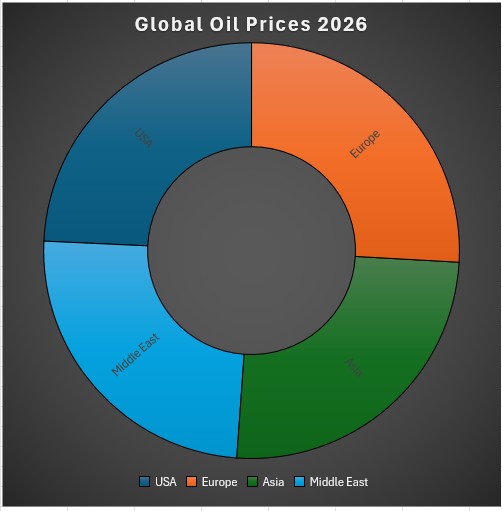
The chart highlights regional differences in oil prices across four major areas in 2026: the United States, Europe, Asia, and the Middle East. Although the variations may seem small, they reveal deeper economic and geopolitical realities shaping global energy markets.
Europe records the highest oil price at approximately $80 per barrel. This is largely due to high taxes, strict environmental regulations, and heavy reliance on imported energy. These factors increase both transportation and refining costs, resulting in higher final prices.
Asia follows closely at around $78 per barrel, driven by strong demand from rapidly growing economies such as China and India. Expanding industrial activity and population growth continue to increase energy consumption, placing upward pressure on prices.
In the Middle East, oil prices average about $76 per barrel. Despite being a major oil-producing region, prices are influenced by internal policies, export strategies, and global market dynamics.
The United States has the lowest price at approximately $75 per barrel, supported by strong domestic production, particularly from shale oil. This reduces reliance on imports and helps stabilize prices within the region.
Looking ahead, oil prices are expected to remain uncertain and highly sensitive to global events. Political tensions, especially in critical regions such as the Middle East, may disrupt supply and increase price volatility. At the same time, rising demand from developing economies is likely to keep upward pressure on prices.
However, the expansion of renewable energy and global efforts to reduce dependence on fossil fuels may gradually limit long-term demand for oil. In addition, decisions made by major oil-producing nations will continue to play a crucial role in either stabilizing or destabilizing the market.
In conclusion, oil prices are not just numbers in a market. They are a powerful force shaping inflation, economic stability, and daily life around the world. As the global energy system evolves, oil will remain a key factor, but its future will depend on a complex balance between geopolitical stability, economic growth, and the transition toward cleaner energy.
Economic Studies Unit – North America Office
Center for Linkage Studies and Strategic Research