
By Shatha Kalel
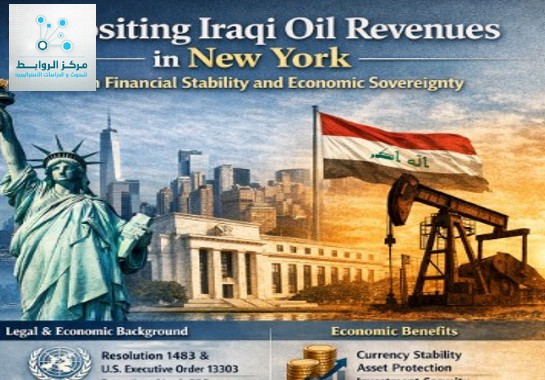
The mechanism for depositing Iraqi oil revenues in accounts held at the U.S. Federal Reserve Bank in New York represents one of the most complex financial arrangements in modern Iraqi history. Since 2003, this mechanism has evolved from a technical safeguard into a central factor shaping Iraq’s economic sovereignty, financial stability, and political relations with global powers.
Legal and Economic Background
Following the 2003 invasion of Iraq, the United Nations Security Council adopted Resolution 1483, which aimed to protect Iraqi oil revenues and state assets from creditor claims and legal actions. At the time, Iraq faced massive external debts accumulated during the previous regime. In parallel, the United States issued Executive Order 13303, granting broad legal immunity to Iraqi oil revenues and assets held under the authority of the Central Bank and the Iraqi government. This order was renewed and amended in subsequent years to reflect developments in Iraq’s debt settlement process.
From an economic perspective, Iraq was in an extremely fragile position. Heavy external debt, institutional collapse, and the absence of international confidence made this arrangement a critical tool for reintegrating Iraq into the global financial system and ensuring stable access to U.S. dollars required for imports and budgetary financing.
Indirect Economic Benefits
This arrangement contributed to several important economic gains. It strengthened international confidence in the management of Iraqi oil revenues, supported exchange rate stability, and reduced the risk of asset seizure abroad. It also created a more attractive investment environment for international oil companies by providing a legal framework that limited exposure to litigation related to oil production and exports in Iraq.
At the macroeconomic level, the system functioned as a financial buffer against external shocks, whether arising from oil price volatility or creditor claims. This helped Iraq maintain a basic level of financial stability during periods of severe political and economic uncertainty.
The Cost to Sovereignty and External Dependence
However, these benefits came at a significant cost to economic sovereignty. Oil accounts for approximately 90 percent of Iraq’s public revenues, and depositing these funds abroad effectively granted the United States substantial leverage over Iraq’s economy. This leverage became particularly evident during politically sensitive moments, when access to Iraqi funds was implicitly or explicitly linked to political decisions.
This situation reflects a classic dilemma faced by rentier states emerging from conflict: the trade-off between short-term financial stability and long-term economic sovereignty. The longer reliance on external protection mechanisms continues, the more difficult it becomes to achieve genuine financial independence.
The International Dimension and Intersecting Files
The issue of oil revenues intersects with broader legal and political matters, including maritime boundary disputes and the submission of geographic coordinates to the United Nations under the United Nations Convention on the Law of the Sea. Iraq’s successive submissions in 2011, 2021, and 2026 reflect gradual attempts to establish a legal position aligned with national interests. At the same time, objections from neighboring states demonstrate that unilateral deposits do not create definitive legal outcomes, and that lasting stability requires negotiated agreements or international adjudication.
A Forward-Looking Assessment
From an analytical economic perspective, the New York deposit mechanism fulfilled an important historical role in protecting Iraq during an exceptional transitional period. Nevertheless, its continued operation in its current form raises fundamental questions about Iraq’s ability to build independent financial institutions, diversify revenue sources, and reduce reliance on external arrangements.
The real challenge does not lie in abruptly dismantling this mechanism, but rather in developing a gradual strategy that transitions Iraq from external financial guardianship toward institutional sovereignty. In such a framework, confidence would stem from the strength of domestic financial systems rather than the location of overseas accounts.
Conclusion
Depositing Iraqi oil revenues in New York is not merely a technical or financial matter. It is a reflection of a history shaped by conflict, debt, and economic restructuring. While the arrangement has provided a degree of stability, it also serves as a reminder that economic sovereignty is measured not only by the volume of revenues generated, but by a state’s capacity to manage and control those revenues within a strong national legal and institutional framework.
Economic Studies Unit – North America Office
Center for Linkage Studies and Strategic Research